

It’s been about a year since I’ve written here. That’s a long silence, and I owe you an explanation. Or maybe not an explanation so much as a confession.
I’ve been building a business. Head down, all in, burning through the kind of manic creative energy that people with ADHD will recognize instantly. The sort of period where you look up and realize a year has evaporated and you forgot to tell anyone what you’ve been doing.
The reason I’m back is that something landed in my feed last week that connected two threads I hadn’t realized were the same thread. And it made me want to write again.
But first, some context.
Six months ago, I sat in front of a blinking cursor, trying to organize the strategy for this business I’d staked everything on.
I had the vision. Crystal clear. I could see the market, the positioning, the exact clients I needed to reach. I could see the whole chessboard.
What I could not do was turn that vision into a structured plan, maintain it across dozens of parallel workstreams, and execute it systematically without losing the thread every few hours.
This is the ADHD tax. Not a lack of intelligence or ambition. A brain that sees everything at once but struggles to hold it all still long enough to build something from it.
For twenty years in corporate America, I white-knuckled my way through this gap. Big teams, institutional structure, and the sheer gravitational pull of corporate process kept me on the rails. It worked. I built programs that generated hundreds of millions in value at Fortune 100 companies.
But the overhead was enormous. The energy I burned just staying organized, just maintaining the appearance of the systematic executive they expected - that cost me as much as the actual work.
Then I left. And everything changed.
The thing that landed in my feed to prompt this post was a Fast Company article. The headline: “Why the ADHD brain is a perfect pairing for AI.”
The piece cites Meredith O’Connor, a mental health counselor who noticed that the skills Fortune 500 executives actually want - creative problem-solving, abstract thinking, empathy, adaptability - are precisely where ADHD brains tend to excel. And the areas where ADHD brains struggle - routine processes, time management, organizing large volumes of information - are precisely where AI excels.
A Drexel University study found that people with strong ADHD symptoms solve problems through insight rather than analysis. Instead of working through steps, their brains make subconscious connections that produce “aha” moments. The highest-performing problem solvers were those with the most ADHD symptoms and those with the fewest. The people in the middle weren’t particularly good at either approach.
Reading that, something clicked.
I didn’t just agree with the research. I’d been living it.
The Partnership Nobody Told Me About
Over the past several months, I’ve been building my business in active partnership with AI. Not using it as a search engine or a glorified autocomplete. Working *with* it the way you’d work with a sharp colleague who never loses focus, never drops a thread, and can hold an impossibly large context in their head while you do the thing your brain was actually built for.
Here is what that looks like in practice.
I’ll have an idea at 7 AM about how to position a service for my target market. By lunchtime, that idea has become a fully structured article, complete with market research, SEO optimization, and internal linking to three other pieces I’d forgotten I’d written. Not because I sat there for five hours grinding through the detail. Because I provided the creative direction - the insight, the angle, the understanding of what that audience actually cares about - and my AI partner handled the systematic execution.
The next day I’ll jump to a completely different workstream. Podcast prep. Client proposals. Website architecture. Email sequences. The kind of context-switching that would have destroyed me in a corporate setting because each jump means rebuilding all the organizational scaffolding in my head.
Except now, the scaffolding lives outside my head. The AI holds the context, the decisions made, the files created, the strategy behind every piece. When I come back to a workstream after three days, I don’t start from zero. I pick up exactly where the momentum was.
For someone whose brain works the way mine does, that isn’t a convenience. It’s transformational.
The Gap That Finally Closed
I want to be specific about what I mean, because “AI helped me be more productive” is the kind of empty statement I’d normally skip past.
My brain generates connections between unrelated ideas at a speed that has always felt like both a gift and a curse. In a meeting, I’d see the strategic implication of something before the person finished their sentence. But I’d lose track of the previous five things discussed while chasing that connection.
In corporate, that made me the person who could see around corners but needed a team of people to build the road. The vision was the easy part. The execution infrastructure was the expensive part.
AI collapsed that gap.
The creative leaps, the pattern recognition across industries, the ability to synthesize a market trend with a client pain point and a content strategy in a single thought - that’s still entirely me. AI can’t do that. The Drexel research confirms it. Spontaneous cognition, insight-based problem solving, connecting dots that don’t obviously belong together - these are profoundly human capabilities, and they tend to run stronger in ADHD brains.
But the sustained attention, the organizational memory, the systematic follow-through, the ability to hold forty parallel workstreams in perfect order - that’s where AI fills the gap so completely it feels less like a tool and more like finding a cognitive partner.
I’m doing the best work of my life. Not in a corporate tower with a big team. In my home office, moving at a speed and level of quality that surprises me on a regular basis. In the past month alone, I’ve shipped a complete website with twenty-five pieces of long-form content, built a podcast workflow, created prospect research systems, and designed an entire content strategy across five channels. All alongside managing top class client work with my team. That isn’t hustle culture. That’s what happens when you stop fighting your brain and start completing it.
The Reframe
Here is the part that made me want to write this.
For most of my life, the narrative around ADHD was about deficit. The name itself leads with “deficit” and “disorder.” The world is designed for neurotypical brains, and if yours doesn’t fit, you’re the one who needs to adapt.
I adapted for twenty years. I was good at it. But the cost was real. The headaches. The burnout. The feeling of running at 60% because so much energy was consumed just keeping the plates spinning.
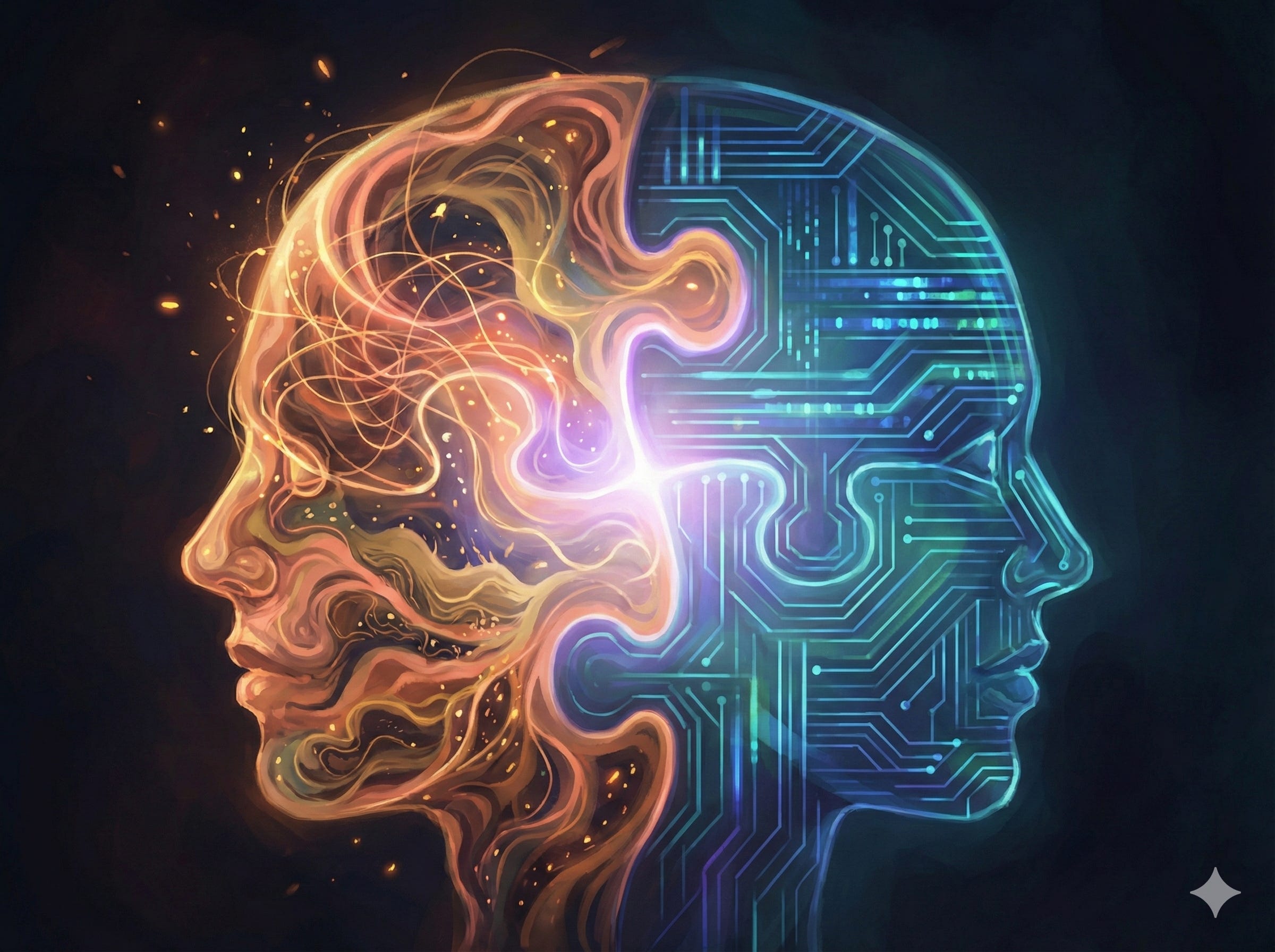
ADHD brains have always had one half of a powerful equation - the creative, insight-driven, pattern-recognizing half. The world just didn’t have a good complement for the other half.
Now it does.
I’m not building my business *despite* how my brain works. I’m building it *because* of how my brain works, with AI handling the parts my brain was never designed for.
If you’re reading this and something resonates - if you’ve spent years feeling like you had the vision but couldn’t maintain the infrastructure, like you could see the whole picture but couldn’t hold it still long enough to paint it - sit with this idea for a minute.
You might not have a productivity problem. You might have a partnership problem.
The tools exist now to complement the exact cognitive profile that traditional environments punish. Not to replace your thinking. To complete it.
I spent twenty years in systems that demanded I suppress my actual strengths to compensate for my weaknesses.
What if the way your brain works was never the problem? What if the problem was that your brain’s other half hadn’t been invented yet?
*The Fast Company article referenced in this piece is [”Why the ADHD brain is a perfect pairing for AI”] by Jared Lindzon, published February 19, 2026.
Great article, Graeme! Shared it with my brother who has ADHD. Lot of gems in your piece. Thank you.
Good to see you back, Graeme. Can’t say I agree with everything you’ve shared, but you always make me think… 🙂